1951 | John H. Cochrane | Feb 17, 2026 | The Grumpy Economist
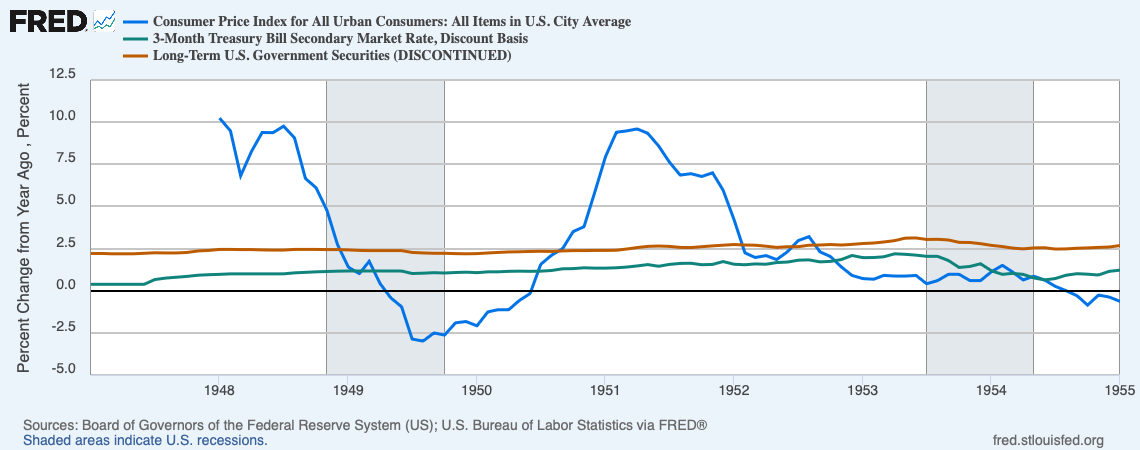
"After World War II ended, the Fed continued its wartime pegging of interest rates. The Treasury-Fed Accord, announced March 4, 1951, freed the Fed from that obligation."
"The Fed pegged long term interest rates at 2.5% during WWII, to hold down interest costs and keep up the prices at which the government sold debt. Inflation surged in 1947 and 1948 when price controls were lifted, but inflation quickly came down again once the price level had caught up. The Fed already wanted to raise rates in the recovery of 1950. The resurgence of inflation during the Korean War in 1951 set the stage for the great battle for independence: Would the Fed continue to peg at 2.5%, printing money to buy bonds as needed? Or should the Fed’s job to contain inflation take precedence? (More technically, the Fed exchanged bonds for bank reserves, accounts banks hold at the Fed, which are freely transferrable to cash and before 2008 did not pay any interest.)"
References
Disclaimer: Orignal content owned by or sourced from third parties. It does not represent the views of 'Nuggets' platform or it's team. AI is used extensively across this platform including for summaries. Accuracy is not guaranteed, there can be mistakes. Any info or content on this platform is not a financial, legal, or investment advice. Do your own research. Refer for complete disclosures:- Terms of Use · Full Disclaimer
More nuggets
Oct 21, 2026
Ken Griffin on AI, Midterm Elections and Fiscal Policy | 21 Oct 2026 | Bloomberg Television
"Work that used to take our PhDs and masters four to six weeks to complete—high level white collar jobs—press a button on a keyboard, wait a few hours, there's the exact same answer." Ken Griffin 00:01:10 http://www.youtube.com/watch?v=mV1…
Oct 19, 2026
Why Jamie Dimon Says Cyber Is America’s Biggest Risk | 19 Oct 2026 | WSJ Leadership Institute
"The job of no one at this company is to make me happy. The job of this company is to do the right thing for the company, the clients, the community, and the country." Jamie Dimon 00:00:09 https://www.youtube.com/watch?v=glrthhLyJr8&t=0m9s…
Oct 18, 2026
Jamie Dimon, Chairman & CEO, JPMorganChase & Co., 10/14/26 | The Economic Club of Chicago
"Take home an annual report, rip out the pages so is the stock price... and then say what you think it's worth. You'll be shocked how wrong you are, and it is humbling about how you value something." — Jamie Dimon 00:07:56 https://www.yout…