3 Investing Principles And Why They Signal International Markets for 2026 | 19 Feb 2026 | RBA · Nuggets
The Three Core Investing Principles The report grounds its outlook in three "tried and true" principles that dictate long-term market performance:
Earnings Growth as the Driver: It is the growth of earnings, rather than the absolute level, that dictates equity performance.Capital Scarcity: Return on Invested Capital (ROIC) is historically highest in areas where capital is scarce.Cycle Rotation: Market winners from the previous cycle are rarely the leaders in the next.
Executive Thesis
Core investing principles suggest international equities are positioned to lead in 2026
Market leadership may rotate away from prior U.S. mega-cap dominance
Earnings momentum, capital scarcity, and macro regime change are the key drivers
Principle 1: Earnings Growth Drives Returns (Not Earnings Levels)
Disclaimer: Orignal content owned by or sourced from third parties. It does not represent the views of 'Nuggets' platform or it's team. AI is used extensively across this platform including for summaries. Accuracy is not guaranteed, there can be mistakes. Any info or content on this platform is not a financial, legal, or investment advice. Do your own research. Refer for complete disclosures:- Terms of Use · Full Disclaimer
More nuggets Oct 21, 2026
Ken Griffin on AI, Midterm Elections and Fiscal Policy | 21 Oct 2026 | Bloomberg Television "Work that used to take our PhDs and masters four to six weeks to complete—high level white collar jobs—press a button on a keyboard, wait a few hours, there's the exact same answer." Ken Griffin 00:01:10 http://www.youtube.com/watch?v=mV1…
Oct 19, 2026
Marc Stad, Founder of Dragoneer: Be Patient, Then Be Bold | 15 Oct 2026 | Stanford Graduate School of Business "Whatever you do do not be a poor kid in Washington at 22 years old Go make some money first and learn how the economy works and how business works." Bob Rubin 00:08:35 https://youtu.be/fpqXvDKhtvQ?t=08m35s "The delta between one in a mill…
Oct 19, 2026
Why Jamie Dimon Says Cyber Is America’s Biggest Risk | 19 Oct 2026 | WSJ Leadership Institute "The job of no one at this company is to make me happy. The job of this company is to do the right thing for the company, the clients, the community, and the country." Jamie Dimon 00:00:09 https://www.youtube.com/watch?v=glrthhLyJr8&t=0m9s…
Reading
Published February 22, 2026
Read time 2 min read
Core Insight
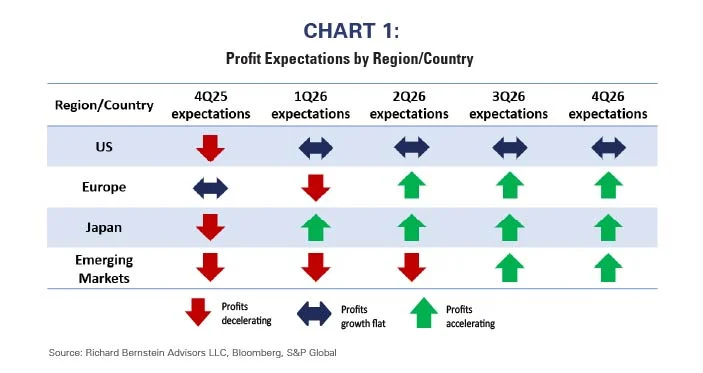
Equity performance follows earnings acceleration, not absolute profit size
Relative momentum matters more than headline numbers
Current Setup (2026 Outlook)
U.S. earnings growth: flattening
International earnings growth: accelerating
Emerging markets: positioned for cyclical improvement
Implication
Leadership likely shifts toward regions with improving earnings trajectories
Developed international markets appear strongest on momentum
Chart 1
Principle 2: Returns Are Higher Where Capital Is Scarce
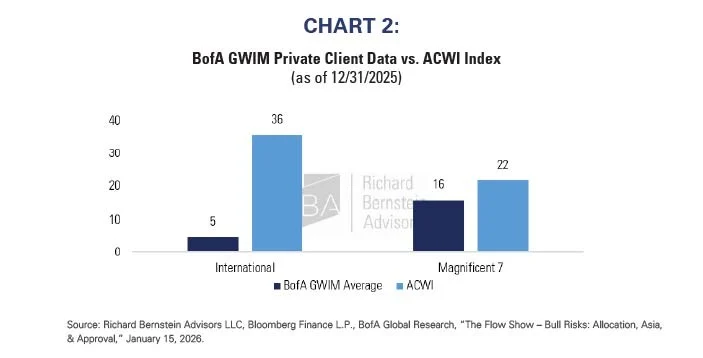
Capital Allocation Imbalance According to Bank of America GWIM private client data:
International equities = 5% average portfolio allocation
International weight in MSCI ACWI = 36%
“Magnificent 7” allocation = 16%
Magnificent 7 ACWI weight = 22%
Interpretation
Massive underweight to international equities
Much larger gap vs. benchmark than U.S. mega-cap underweight
Scarcity of capital → potential for higher forward returns
Chart 2
Principle 3: Last Cycle’s Winners Rarely Repeat
Previous Cycle (2010–2021)
Low inflation
Zero interest rates
Quantitative easing
Concentrated earnings growth
Long-duration assets outperformed
Mega-cap tech dominance
Emerging Regime (2026+)
Stickier inflation
Higher interest rates
Less central bank liquidity
Broader earnings growth
Likely Beneficiaries
International markets
Value stocks
Industrials
Small caps
Commodity-sensitive sectors
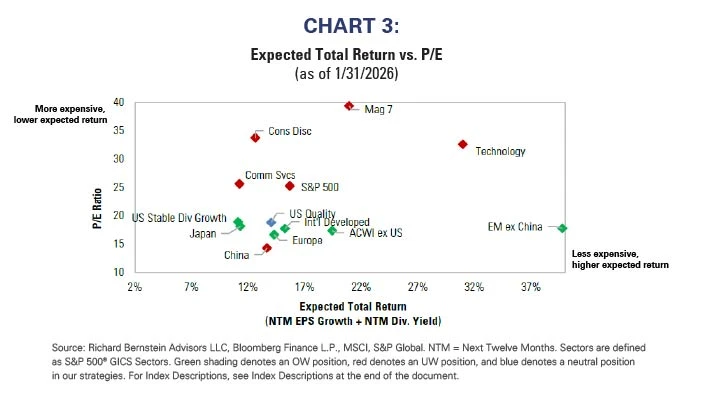
Chart 3
Market Rotation Underway
Investors remain crowded in:
AI
Crypto
Mega-cap growth
Breadth expanding outside U.S.
Broader opportunity set than any period since 2010
Historical Analogy
In 2010, pessimism toward U.S. equities created opportunity
Today: similar skepticism toward international markets
Improving fundamentals + low positioning = asymmetrical setup
Portfolio Positioning (RBA View) As articulated by Deputy CIO Michael Contopoulos:
Overweight developed international equities
Selective emerging market exposure
Tilt toward cyclical/value-oriented sectors
Underweight crowded long-duration trades
Strategic Takeaways for Investors
Focus on earnings acceleration, not past winners
Recognize capital scarcity outside the U.S.
Prepare for leadership rotation
Diversify beyond mega-cap concentration
Position for a structurally different macro regime
Bottom Line The three timeless principles converge on one conclusion:
International markets are structurally better positioned for leadership in 2026 due to earnings momentum, capital scarcity, and regime change.
Jamie Dimon, Chairman & CEO, JPMorganChase & Co., 10/14/26 | The Economic Club of Chicago "Take home an annual report, rip out the pages so is the stock price... and then say what you think it's worth. You'll be shocked how wrong you are, and it is humbling about how you value something." — Jamie Dimon 00:07:56 https://www.yout…