NNuggets
BookmarksCollections
  • About Us
  • Terms of use
  • Privacy policy
  • Disclaimer
  • Copyright & Takedown Policy
  • Community Guidelines
  • Cookie Policy
  • Contact

© 2026 Nuggets

NuggetsMarket PulseCollections

On this page

America’s ‘can-do’ spirit

  • America’s ‘can-do’ spirit

On this page

  • America’s ‘can-do’ spirit
Technology/March 15, 2026/3 min read/mckinsey.com

Selection of top 100 inventions with US involvement highlighted | McKinsey

Source

McKinsey: The United States has led the invention of new products, systems, and technologies over the past 250 years.

America’s ‘can-do’ spirit

From its inception to this day, the United States has had an entrepreneurial culture that has served as an ongoing foundation for competitiveness. By some accounts, entrepreneurs and inventors have been “cultural heroes” throughout US history. Entrepreneurship in America —often supported by wealth earned from its resources—has meant a willingness to take risks, an embrace of new ideas and people, and a drive for economic progress. As Alexis de Tocqueville wrote in 1840: “America is a land of wonders, in which everything is in constant motion and every change seems an improvement. No natural boundary seems to be set to the efforts of man; and in his eyes what is not yet done is only what he has not yet attempted to do.”

The culture of entrepreneurship stems at least in part from the absence of Europe’s entrenched societal structures and systems; the United States was able to start fresh. Perceived openness and economic opportunity have attracted many of the world’s best minds over the country’s history. In the second chapter, for example, immigrants brought new ideas and had an outsize impact on innovation; migrants from this era were more than 1.5 times likelier to file a patent than their US-born peers. Andrew Carnegie, an immigrant from Scotland, famously started a steel empire that became the world’s largest corporation. This phenomenon has endured.

References

  1. Original source (mckinsey.com)

Disclaimer: Orignal content owned by or sourced from third parties. It does not represent the views of 'Nuggets' platform or it's team. AI is used extensively across this platform including for summaries. Accuracy is not guaranteed, there can be mistakes. Any info or content on this platform is not a financial, legal, or investment advice. Do your own research. Refer for complete disclosures:- Terms of Use · Full Disclaimer

Related nuggets

Jun 2, 2026

AI Is Escaping the Screen | 01 Jun 2026 | Coatue

Coatue : AI is entering a new phase: moving beyond digital tools and into fully autonomous systems operating in the physical world. From advanced manufacturing and surgical robotics to robots in the home, the next wave of innovation will b…

Jun 2, 2026

Kalshi Monthly Volume - Politics ($M) | Chart of the Day | Coatue

Coatue: Kalshi's political volume has scaled dramatically, and the American Power Index KPOW is what that scale enables: a single number gauge of the current balance of political power and where markets expect it to move, which Kalshi bill…

Jun 2, 2026

The BlackBerry Problem |18 May 2026 | The Mistakes Series | Malcolm Gladwell's Revisionist History

"My mistake and naivity was to think that people are were with me so you're flying around the world you're trying to get people on side and you think they're on side but they're not mhm mhm and you get blindsight" Jim Balsillie 00:01:34 ht…

Jun 2, 2026

Partnership Perspectives: Network International | 2 Jun 2026 | Brookfield Perspectives

Actions

Reading

Published
March 15, 2026
Read time
3 min read
Progress0%
In 2024, 46 percent of Fortune 500 firms had at least one founder who was a first- or second-generation immigrant, according to a recent study.

From steamboats in the first chapter to smartphones in the fourth, the United States has been a leader in invention. Americans came up with or collaborated on the vast majority of the most important inventions of the past 250 years (table attached). The nature of invention changed over time, as did who funded it. 

  • In the first chapter, self-taught tinkerers and artisans such as Eli Whitney led the charge.
  • In the second, the industrial research lab took center stage, providing capital to inventors such as Thomas Edison and Nikola Tesla.
  • In the third, collaborations between government, universities, and businesses mobilized teams such as a group at Bell Labs led by William Shockley, John Bardeen, and Walter Brattain, co-inventors of the first transistor. During this chapter, funding for R&D primarily came from government, with strong incentives rooted in Cold War–era geopolitical competition.
  • In the fourth, business once again played a larger role in funding R&D. Knowledge ecosystems, including universities and venture capital–backed start-ups, became the centers of invention, with figures such as Steve Jobs envisioning products and ways of interacting with technology such as smartphones, backed by teams that turned those ideas into reality.

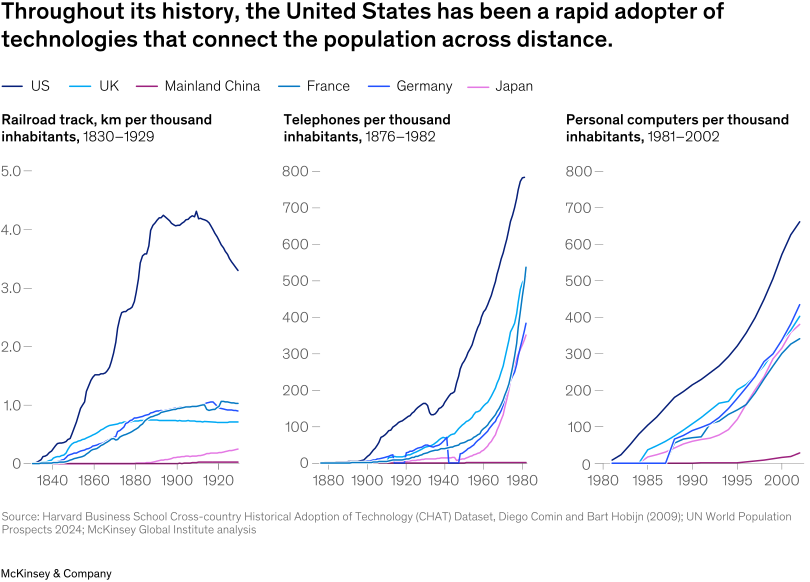
The entrepreneurial spirit of the United States was not limited to tech visionaries. It was also embedded in the American people and business community, who have long had the appetite (and means) to adopt and scale new technologies, including those invented elsewhere, such as the automobile, first developed in Germany in 1885. Over time, inventions such as railroads, telephones, and personal computers were adopted more quickly in the United States than elsewhere. The effects on the economy and the fabric of life were manifold: better connections, greater economies of scale, and faster transportation, communication, and learning. While these examples are historical, the same can be said of some more recent technologies; for example, the United States has been at the forefront of scaling cloud computing services.

Exhibit 13
Exhibit 13

Americans have adopted generative AI even faster than earlier transformative technologies. That said, however, other countries have been faster; a recent ranking puts the United States in 24th place for adoption rates, behind many other G7 economies. As discussed, Chinese companies are embedding AI at a rapid clip. This raises the crucial questions of whether the United States can maintain this foundation of competitiveness, and, if lost, what reclaiming it might take.

Source: At 250, sustaining America’s competitive edge

"Brookfield's the largest infrastructure owner in the world... We drew a pipeline and we showed all the different components of the payments ecosystem on a pipeline and said it's like a pipe that moves any commodity except what it's moving…