NNuggets
BookmarksCollections
  • About Us
  • Terms of use
  • Privacy policy
  • Disclaimer
  • Copyright & Takedown Policy
  • Community Guidelines
  • Cookie Policy
  • Contact

© 2026 Nuggets

NuggetsMarket PulseCollections
Fixed Income/February 25, 2026/2 min read/research.db.com

Geopolitical shocks do not tend to affect UST yields independent of their impact on oil prices | Deutsche Bank
Source

- TheBondBeat Substack

The results indicate that positive oil price moves and data surprises significantly lift yields, higher policy uncertainty lowers them, and geopolitical shocks have no direct impact. 

These findings are robust to running the analysis on daily instead of monthly data, entering the geopolitical and policy uncertainty indexes in levels rather than changes, and including the lagged change in the 10y UST as a regressor to control for any yield-momentum effects. Together, this suggests that, as far as UST yields are concerned, the main mechanism / variable to track on current Iran developments is the price of oil.

References

  1. Original source (research.db.com)

Disclaimer: Orignal content owned by or sourced from third parties. It does not represent the views of 'Nuggets' platform or it's team. AI is used extensively across this platform including for summaries. Accuracy is not guaranteed, there can be mistakes. Any info or content on this platform is not a financial, legal, or investment advice. Do your own research. Refer for complete disclosures:- Terms of Use · Full Disclaimer

Related nuggets

Jun 2, 2026

AI Is Escaping the Screen | 01 Jun 2026 | Coatue

Coatue : AI is entering a new phase: moving beyond digital tools and into fully autonomous systems operating in the physical world. From advanced manufacturing and surgical robotics to robots in the home, the next wave of innovation will b…

Jun 2, 2026

Kalshi Monthly Volume - Politics ($M) | Chart of the Day | Coatue

Coatue: Kalshi's political volume has scaled dramatically, and the American Power Index KPOW is what that scale enables: a single number gauge of the current balance of political power and where markets expect it to move, which Kalshi bill…

Jun 2, 2026

Partnership Perspectives: Network International | 2 Jun 2026 | Brookfield Perspectives

"Brookfield's the largest infrastructure owner in the world... We drew a pipeline and we showed all the different components of the payments ecosystem on a pipeline and said it's like a pipe that moves any commodity except what it's moving…

Jun 1, 2026

Brendan Greeley on the 500 Year History of the Dollar | 1 Jun 2026 | Macro Musings

Actions

Reading

Published
February 25, 2026
Read time
2 min read
Progress0%

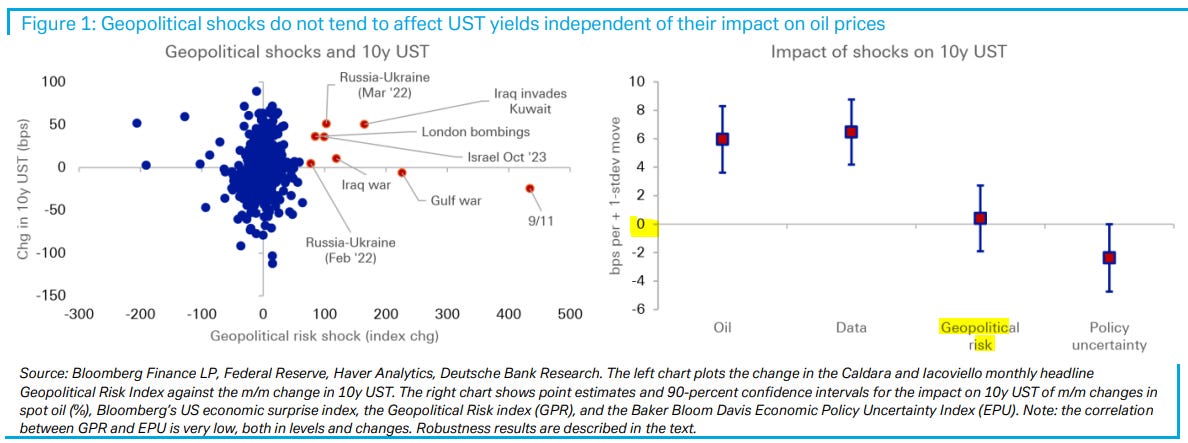
DB: With tensions around Iran in focus, today’s chart explores the impact of geopolitical shocks on the 10y Treasury yield. (See here for views on Iran from our geopolitical risk strategists.)

To measure geopolitical risk, we use the GPR index developed by Fed Board staff (Caldara and Iacoviello), which is based on the number of articles in a set of top newspapers that are related to adverse geopolitical threats and actions (e.g., wars, military buildups, terrorism). As a baseline, we use the headline monthly index (available back to 1985), though as discussed below also explore the robustness of our findings using the daily GPR index.

The left chart plots geopolitical shocks (measured as the month-on-month index change) on the x-axis and the corresponding change in 10y UST on the y-axis; the largest shocks over the last thirty years are separately labelled. Most striking is that these have almost all been associated with higher yields, contrary to a view that geopolitical risk is inherently bullish for duration through safe-haven flows.

Of course, as the labels on the big shocks make clear, most have been associated with energy supply disruptions and so would be expected to boost yields through higher oil prices. To control for this and isolate the impact of geopolitics through other channels, we run an OLS regression of the m/m change in 10y UST over the past thirty years on four variables: the change in spot oil prices, economic data surprises, geopolitical shocks, and economic policy uncertainty shocks (measured using Baker Bloom Davis). The results are shown in the right chart, which plots the estimated impact on 10y UST (in bps) of a +1-standard deviation move in each variable and the associated 90-percent confidence intervals.

The results indicate that positive oil price moves and data surprises significantly lift yields, higher policy uncertainty lowers them, and geopolitical shocks have no direct impact. These findings are robust to running the analysis on daily instead of monthly data, entering the geopolitical and policy uncertainty indexes in levels rather than changes, and including the lagged change in the 10y UST as a regressor to control for any yield-momentum effects. Together, this suggests that, as far as UST yields are concerned, the main mechanism / variable to track on current Iran developments is the price of oil.

"Alexander Hamilton called it the ancient dollar it was already an established uh uh unit of measure it was already an established currency well before the United States" Brendan Greeley 00:06:55 https://youtu.be/QiX7KmApTtI?si=cdzwMESLY6t…