NNuggets
BookmarksCollections
  • About Us
  • Terms of use
  • Privacy policy
  • Disclaimer
  • Copyright & Takedown Policy
  • Community Guidelines
  • Cookie Policy
  • Contact

© 2026 Nuggets

NuggetsMarket PulseCollections

On this page

Modern Examples of Jevon's Paradox

  • Modern Examples of Jevon's Paradox
  • Jevon's Paradox and AI

On this page

  • Modern Examples of Jevon's Paradox
  • Jevon's Paradox and AI
Knowledge Byte/March 14, 2026/2 min read/sketchplanations.com

What is Jevon's Paradox? | Concepts
Source

Jevon's Paradox
Jevon's Paradox

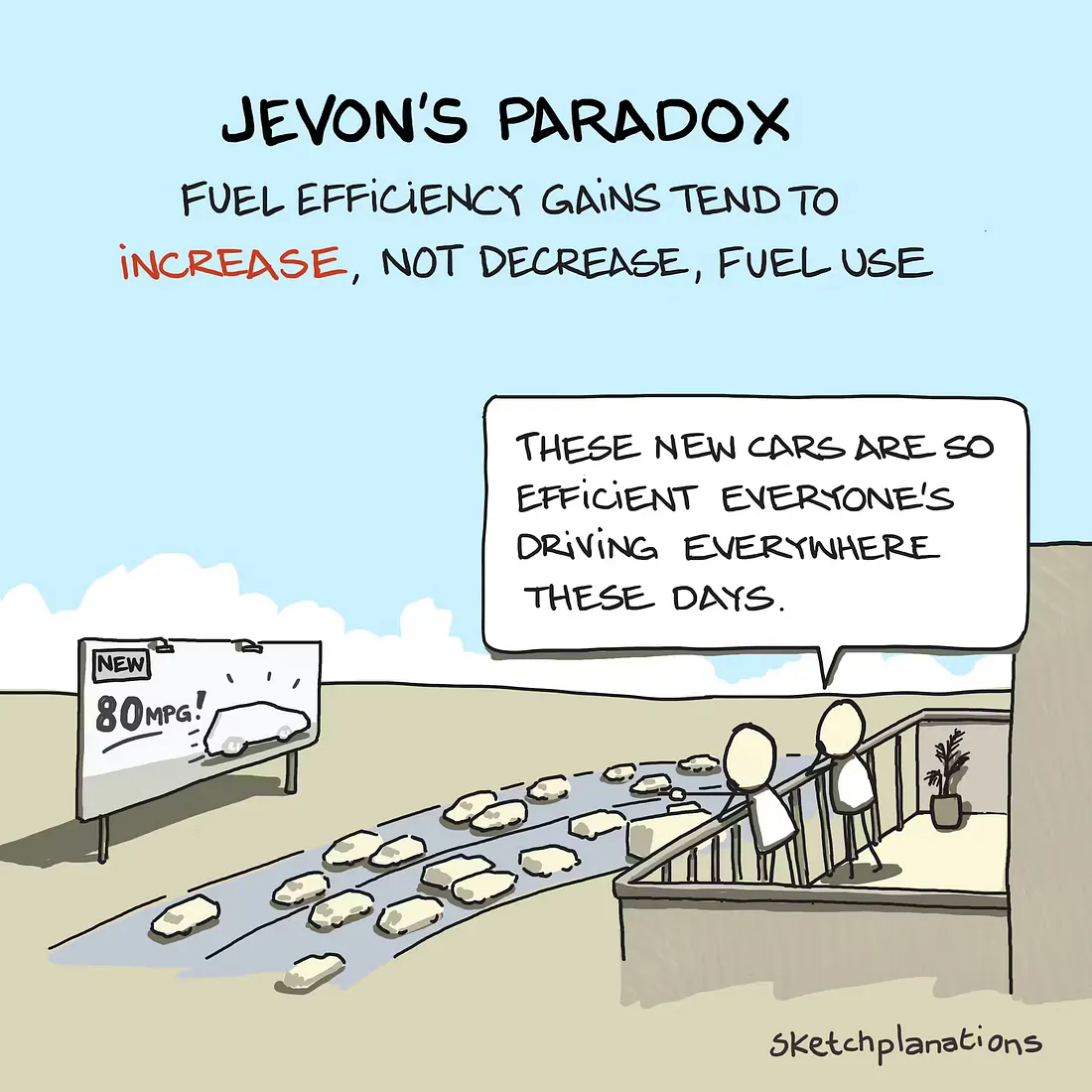
Jevon's Paradox is the counterintuitive idea that improvements in efficiency (in this case fuel) tend to increase, rather than decrease, overall use of that resource (in this case fuel).


In 1865, William Stanley Jevons, a British economist, observed that despite significant improvements in coal efficiency in steam engines, total coal consumption actually rose. Rather than saving fuel, efficiency made coal-powered energy more economical, driving increased industrial use. This observation became known as Jevon's Paradox.

Modern Examples of Jevon's Paradox

Though first identified towards the end of the Industrial Revolution, Jevon's Paradox is still highly relevant today, particularly in discussions around energy efficiency, sustainability, and technology.

  • Fuel-efficient cars – When vehicles become more fuel-efficient, the cost per mile driven decreases. As a result, people tend to , offsetting the efficiency gains.

References

  1. Original source (sketchplanations.com)

Disclaimer: Orignal content owned by or sourced from third parties. It does not represent the views of 'Nuggets' platform or it's team. AI is used extensively across this platform including for summaries. Accuracy is not guaranteed, there can be mistakes. Any info or content on this platform is not a financial, legal, or investment advice. Do your own research. Refer for complete disclosures:- Terms of Use · Full Disclaimer

Related nuggets

Jun 2, 2026

The BlackBerry Problem |18 May 2026 | The Mistakes Series | Malcolm Gladwell's Revisionist History

"My mistake and naivity was to think that people are were with me so you're flying around the world you're trying to get people on side and you think they're on side but they're not mhm mhm and you get blindsight" Jim Balsillie 00:01:34 ht…

Jun 2, 2026

The Brilliant Mr. Feynman (Update) | Part 2| Freakonomics Radio

Link to Part 1 : The Curious Mr. Feynman Update https://www.nuggets.one/nuggets/1736af65 99d3 48c5 9978 1c66e73a4680/the curious mr feynman update part one of a three part series freakonomics radio 1736af "It is an atomic bomb. It is a har…

Jun 1, 2026

Brendan Greeley on the 500 Year History of the Dollar | 1 Jun 2026 | Macro Musings

"Alexander Hamilton called it the ancient dollar it was already an established uh uh unit of measure it was already an established currency well before the United States" Brendan Greeley 00:06:55 https://youtu.be/QiX7KmApTtI?si=cdzwMESLY6t…

Jun 1, 2026

Actions

Reading

Published
March 14, 2026
Read time
2 min read
Progress0%
drive more
  • AI and computing power – Advances in AI and computing efficiency reduce the cost of processing power, leading to increased overall usage of AI models and cloud computing.
  • Battery technology – More efficient batteries lead to the proliferation of battery-powered devices rather than reducing energy consumption.
  • Water-saving devices – Low-flow showerheads and toilets may save water per use, but in some cases, they lead to longer showers or more frequent flushing.
  • Lighting — Though LED lights are vastly more efficient than their predecessors, we are continually finding new ways to use our low-wattage lights that we had never dreamed of before.
  • Household appliances – In her book More Work for Mother , Ruth Cowan addresses the ironies of household appliances, such as washing machines and vacuum cleaners, and how improvements in efficiency often led to more work through more frequent washing, not less.
  • This tendency is sometimes referred to as the rebound effect , where changes in behaviour partially or fully cancel out expected energy or resource savings.


    Jevon's Paradox and AI

    With the rise of AI and automation, Jevon's Paradox is playing out again in new ways:

    • Computational efficiency – Though AI models are becoming more efficient—DeepSeek a case in point—the demand for AI-generated content, large language models, and deep learning applications is growing rapidly.
    • Automated processes – Instead of reducing overall workloads, automation often leads to more tasks being completed rather than fewer tasks needing to be done.
    • Cloud computing – More efficient data centres have not reduced overall energy use because the demand for cloud services and machine learning applications continues to skyrocket.

    Peptides: The Science, Uses & Safety | Dr. Abud Bakri | 1 Jun 2026 | Huberman Lab

    "The body likes these different languages to communicate between cells going from DNA to RNA to proteins... and peptides are one of these languages." Dr. Abud Bakri 00:04:26 https://youtu.be/ DfqnpSbMfE?si=5tW QYZstnK 8ErD&t=4m26s "I think…