What is Techno-nationalism? | Knowledge Bytes
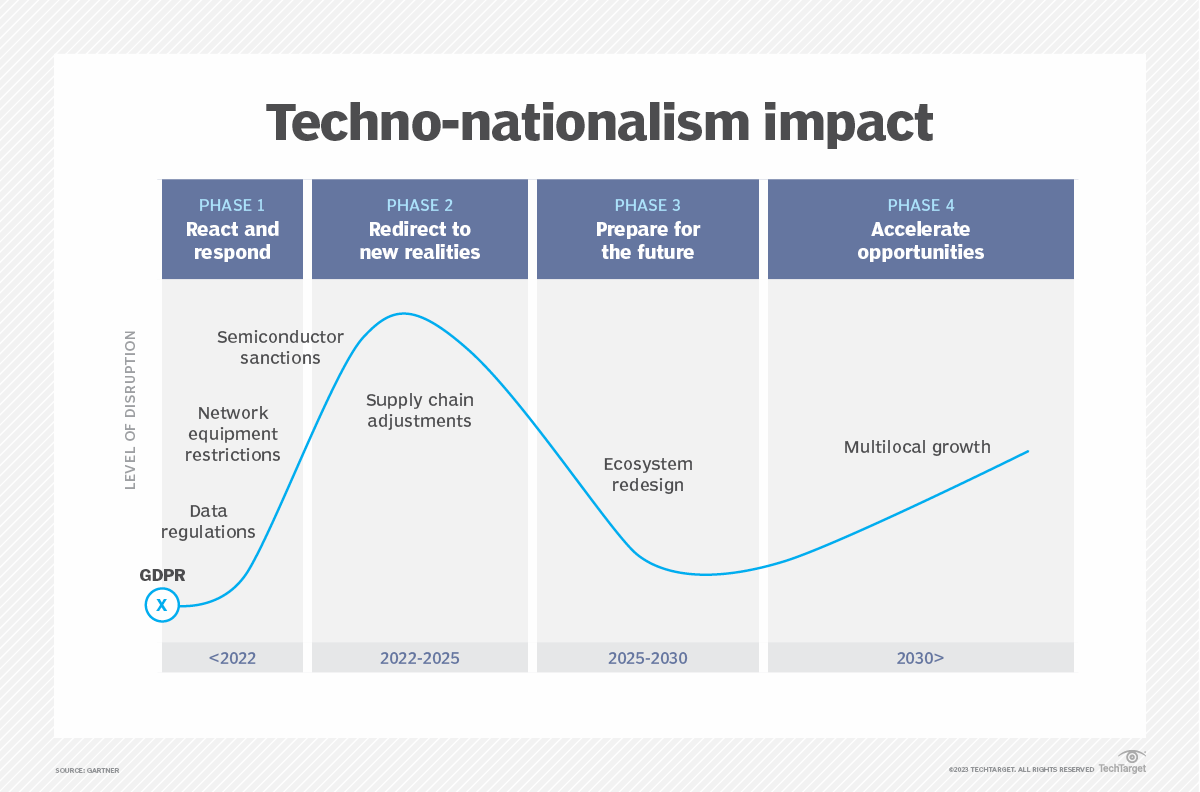
Techno-nationalism is a mercantilist ideology linking technological innovation directly to national security, economic prosperity, and social stability. It involves governments prioritizing homegrown technology, restricting foreign technology access, and treating high-tech sectors (like semiconductors, AI) as vital national assets, often in a zero-sum competition.
Key Characteristics
- Zero-sum Competition: The belief that one nation's gain in technology is another's loss, common between superpowers like the US and China.
- Intersection of Security/Economy: Tech is treated as a security issue, not just commercial.
- Rise of "Trust" Networks: Trusted allies are favored for technology partnerships over rivals.
Techno-nationalism is the direct antithesis of techno-globalism, which promotes open, shared innovation.
Usage Examples of Techno-nationalism
-
Export Controls & Sanctions: The U.S. restricting China’s access to advanced semiconductor technology and AI chips.
-
Supply Chain Reshoring/Ring-fencing: Governments incentivizing domestic manufacturing (e.g., U.S. CHIPS Act) to reduce dependence on foreign suppliers.
-
Restricting Investment: Blocking foreign acquisitions of sensitive local tech companies (e.g., screening Chinese investments in European or American firms).
-
Data Sovereignty: Implementing local data storage regulations to control surveillance and privacy, treating intellectual property as state secrets.
-
Support for Domestic Tech Giants: Favouring homegrown companies (e.g., Huawei in China) through state subsidies and public procurement.
Source: - Google Gemini
Techno-nationalism can be demonstrated in government policies and national strategies for technical innovation. A couple recent examples of techno-nationalist policies and strategies are the following:
- **China's Made in China 2025 plan. **Started in 2015, Made in China 2025 seeks to decrease China's dependency on foreign supply chains. The plan targets several industries, including AI, quantum computing, robotics, agricultural equipment and self-driving cars. The plan seeks to achieve 70% domestic content of core components and materials by 2025.
- America's CHIPS and Science Act of 2022. The CHIPS (Creating Helpful Incentives to Produce Semiconductors) and Science Act of 2022 is an act designed to increase U.S. competitiveness, innovation and national security by investing in domestic semiconductor manufacturing. The act directs $280 billion in spending over the next 10 years with the majority of the funding going to scientific research and commercialization.
References
Disclaimer: Orignal content owned by or sourced from third parties. It does not represent the views of 'Nuggets' platform or it's team. AI is used extensively across this platform including for summaries. Accuracy is not guaranteed, there can be mistakes. Any info or content on this platform is not a financial, legal, or investment advice. Do your own research. Refer for complete disclosures:- Terms of Use · Full Disclaimer
More nuggets
Oct 8, 2026
Why I Can’t Stop Thinking About ‘The End of History’ | 11 Sept 2026 | The Ezra Klein Show
"liberal democracy might win... but it might win at top a cramped and partial vision of the human soul one that believed in our ability to consume but had little room for our desire for recognition for greatness for daring" Ezra Klein 00:0…
Oct 8, 2026
What Francis Fukuyama Is Seeing at ‘The End of History’ | 17 Sept 2026 | Odd Lots
"In addition to material needs, human beings want to be recognized for their basic human dignity... a lot of our dignity comes from the work we do." Francis Fukuyama 00:00:41 http://www.youtube.com/watch?v=9aL5DtIbDJ0&t=0m41s "The end of h…
Oct 8, 2026
The US propaganda campaign to raise money for World War One | 7 Oct 2026 | The Story of Money | Financial Times
"the Liberty Loan program was basically the genesis moment for the mightiest biggest baddest financial market on the planet The US Treasury market" Robin Wigglesworth 00:00:00 http://www.youtube.com/watch?v=GUeTwjiGEZI&t=00m00s "it might b…