"Chinese high growth is slightly inequality increasing at the world level because China then becomes further apart from poor countries like Sudan, Ethiopia, Congo..." - Branko Milanovic [00:00:22]
"What is happening now is that we take this entire international part, chop it off, and say... what applies now is essentially national, sort of mercantilist policy." - Branko Milanovic [00:08:53]
Disclaimer: Orignal content owned by or sourced from third parties. It does not represent the views of 'Nuggets' platform or it's team. AI is used extensively across this platform including for summaries. Accuracy is not guaranteed, there can be mistakes. Any info or content on this platform is not a financial, legal, or investment advice. Do your own research. Refer for complete disclosures:- Terms of Use · Full Disclaimer
"The change in China is just at the level that we have not historically seen... in terms of size of the population and the speed, we do not have an equivalent case." - Branko Milanovic [00:38:27]
"I do actually believe that there is a case for taxing extraordinary wealth and I have called it... a pedagogical tax... to tell people with extraordinary wealth: 'You are not going to rule us.'" - Branko Milanovic [00:54:06]
"The world that we believed in 1990 was not the real world, that was a fantasy world, and that means that that ideology which underpinned that fantasy world was a fantasy ideology." - Branko Milanovic [00:50:46]
Speakers & Credentials
Joe Weisenthal: Executive Editor and Co-host of Bloomberg's Odd Lots podcast.
Tracy Alloway: Executive Editor and Co-host of Bloomberg's Odd Lots podcast.
Branko Milanovic: Senior Scholar at the Stone Center on Socio-Economic Inequality at the CUNY Graduate Center, former lead economist in the World Bank's Research Department, and author of The Great Global Transformation: The United States, China, and the Remaking of the World Economic Order.
1. Executive Summary
The post-Cold War neoliberal order defined by uninhibited globalization, free capital mobility, and low tariffs is expiring, replaced by a system of "National Market Liberalism" 00:07:43.
While domestic economies retain market-oriented principles, international trade policies have severed global commitments in favor of mercantilist, zero-sum economic nationalism 00:08:53.
China's historic economic trajectory has shifted its role from an automatic reducer of global inequality to an arithmetical contributor to global inequality as its median income outpaces developing nations in Africa 00:00:22.
Western working-class relative decline stems from a structural shift in global income percentiles, dropping lower-percentile European and American workers down the global wealth hierarchy 00:17:35.
Western elites are increasingly characterized by "homoploutia"—an unprecedented alignment where the top 10% simultaneously dominate both labor earnings and capital distribution 00:30:24.
Geopolitical re-shoring and supply chain isolation are driven by national security imperatives, rendering the 1990s vision of frictionless international trade a historical anomaly 00:49:54.
2. Chronological Table of Contents
00:00:00 - Intro & China's Changing Role in Global Inequality
00:06:16 - Guest Introduction & The Concept of "National Market Liberalism"
00:13:29 - Western Perception Gaps vs. Economic Realities of Modern China
00:17:02 - Global Income Percentiles & The Elephant Chart Dynamics
00:22:00 - The 1990s Neoliberal Consensus & China's Strategic Patience
00:24:38 - Domestic Savings, Consumption Ratios, and State Industrial Policy
00:27:32 - Cultural Isolationism & Limits of Chinese Soft Power
00:30:08 - Homoploutia and the Character of Modern Meritocratic Elites
00:36:10 - Velocity of Industrialization: UK (150 Years) vs. China (40 Years)
00:39:12 - Free Trade, Commercial Interdependence, and Great Power Conflicts
00:41:54 - European Deindustrialization, Energy Shocks, and Demographics
00:47:03 - Global Backlash to Efficiency: Developing World's "China Shock"
00:52:22 - Sub-Saharan African Growth as the 21st Century Inequality Pivot
00:53:54 - Wealth Redistribution, Policy Frameworks, and the "Pedagogical Tax"
00:54:41 - Political Economy of Populism: Trump, Xi Jinping, and Oligarchic Control
3. Detailed Thematic Summary
Transitioning from Neoliberal Globalization to National Market Liberalism
The post-1974 international order, which reached its zenith in the unipolar neoliberal consensus following the collapse of the Soviet Union in 1989, has officially expired 00:07:11. It is replaced by a framework termed "National Market Liberalism" 00:07:43. Under classic neoliberalism, policy combined domestic market deregulation with international free trade, low tariffs, capital mobility, and flexible labor movement aspirations 00:08:38. National Market Liberalism retains domestic free-market competition, pricing, and capital structures, but severs the international component 00:08:53. External economic policies adopt zero-sum mercantilism, re-shoring, and explicit tariff barriers 00:07:58. This shift represents a structural pivot from global integration back to state-centric economic protectionism 00:09:02.
China's Economic Shift & Global Inequality Dynamics
Between 1990 and the mid-2010s, China acted as an automatic reducer of global inequality due to its massive population growing rapidly from a low baseline income 00:00:08. However, as China reached upper-middle-income status, its continued ~8% growth trajectory transitioned arithmetically into an engine of global inequality expansion 00:00:57. Its expanding wealth pushes it further away from low-income developing nations such as Sudan, Ethiopia, and the Democratic Republic of the Congo 00:00:31.
Simultaneously, the relative global status of the Western working class has deteriorated 00:17:35. Thirty years ago, an Italian in the bottom 10th percentile of domestic income occupied the 70th percentile globally 00:17:49. Today, that same relative position has dropped to the 55th global percentile 00:17:52. This relative decline explains Western domestic political realignment and resistance to global market openness 00:18:11.
The Political Economy of State Capitalism and Domestic Consumption
China maintains a compressed domestic consumption-to-GDP ratio of roughly 40-45%, compared to 70% in the United States and 50% in India 00:25:11. Rather than distributing corporate revenues to households to boost consumer spending, state-owned enterprises retain high profits 00:25:26. This retained capital fuels targeted state-directed capital expenditures in high-speed rail, artificial intelligence, space exploration, electric vehicles, and commercial aviation 00:25:34. Wage growth compression remains politically sustainable because real wages continue to increase by 3% to 5% annually, down from historical highs of 8% 00:26:24.
Homoploutia and the Structure of the Modern Western Elite
Modern Western capitalism is increasingly characterized by "homoploutia"—a structural phenomenon where individuals in the top 10% of the income distribution concurrently occupy the top 10% of both capital ownership and labor income 00:30:24. Historically, 19th-century capitalists like J.P. Morgan derived income purely from capital assets without performing wage labor 00:31:44. Modern elites combine high-level labor compensation with substantial dividend and capital gain returns 00:32:03.
This fusion creates a self-reinforcing meritocratic aristocracy 00:32:25. Because this class works long hours and relies on elite academic credentials, its members maintain a deep conviction that their economic dominance is morally justified 00:33:01. This self-perception makes them exceptionally durable and resistant to traditional tax or regulatory disruption 00:34:47.
Historical Speed of Class Transformation: UK vs. China
Data tracking elite income composition reveals an unprecedented transformation in China's class structure over a four-decade period 00:37:05:
Elite Income Composition (Top 5% Urban)
┌───────────────────────────────────────────────────────────┐
│ 1988: 66% State / Party / SOE  │ 33% Private Sector       │
├───────────────────────────────────────────────────────────┤
│ 2023: 33% State / Party / SOE  │ 66% Private Sector       │
└───────────────────────────────────────────────────────────┘
In the United Kingdom, the historical shift where private asset owners replaced landed aristocrats at the top of the economic hierarchy required 150 years (1688 to ~1838) 00:38:07. China executed the exact same structural shift in just 40 years (1978 to 2018) 00:38:27.
Structural Headwinds Facing European Competitiveness
The European economic model faces structural decline due to three simultaneous disruptions 00:42:42:
Energy Cost Shock: Cutting off cheap Russian natural gas forced European industry to rely on more expensive imported American Liquefied Natural Gas (LNG) 00:42:55.
Demographic Decline: Persistent native population declines coincide with widespread political resistance to large-scale immigration, restricting labor supply 00:43:07.
Industrial Competition: The "China Shock" in advanced manufacturing (particularly electric vehicles) threatens Germany's core industrial export model 00:43:51.
Sub-Saharan Africa as the Primary Axis of 21st-Century Inequality
With China's transition to a higher income tier, the future trajectory of global inequality depends almost entirely on economic growth in Sub-Saharan Africa 00:52:41.
Sub-Saharan Africa Demographics
• Population: ~1 Billion people across 5-6 key nations
• Key Nations: Nigeria (220M+), Ethiopia, DRC, Tanzania, Kenya, Uganda
• Annual Population Growth Rate: ~2% (only region maintaining this rate globally)
If Sub-Saharan Africa fails to achieve sustained high GDP growth rates over the coming decades, global inequality between individuals will surge upward once again 00:53:35.
The Reference Vault
4. Data & Figures
Data Point
Value
Context
Timestamp
Chinese Target Growth Threshold
8%
Annual growth rate that increases global inequality arithmetically
National Market Liberalism describes the modern economic consensus that replaces neoliberal globalization 00:07:43. Under this framework, nation-states preserve free-market principles, price deregulation, and capitalist competition domestically, while completely abandoning open-market principles at their borders 00:08:53. Instead, foreign trade policy adopts protectionism, tariffs, and industrial subsidies 00:07:58. The model reflects a broader shift where states prioritize national security and supply chain independence over global economic efficiency 00:51:22.
Homoploutia
Homoploutia defines an elite structure where the same individuals occupy the top ranks of both labor income and capital income distributions 00:30:24. Unlike 19th-century rentiers who accumulated wealth passively, modern homoploutists earn high executive or professional salaries while owning substantial financial assets 00:32:03. This creates a highly resilient elite that defends private property through capital ownership while claiming political legitimacy through high academic and professional achievement 00:33:01.
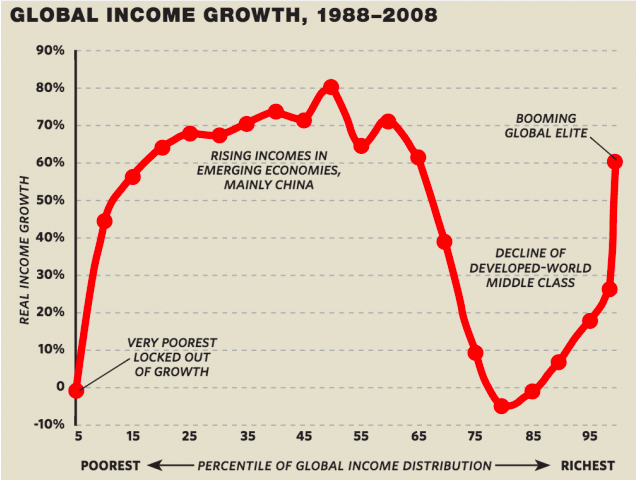
The Elephant Chart of Global Inequality
The Elephant Chart illustrates changes in real income growth across global income percentiles from 1988 to 2008 00:19:28. It highlights three key dynamics:
Significant real income gains for the emerging Asian middle class (the "back" of the elephant) 00:19:59.
Stagnant real income growth for the Western lower-middle class (the "trough") 00:19:45.
Massive income accumulation among the top 1% globally (the "tip of the trunk") 00:19:52.
The Pedagogical Tax is a theoretical policy framework for taxing extreme wealth 00:54:06. Rather than aiming solely at revenue generation, its primary function is political instruction: explicitly limiting the power of ultra-wealthy individuals over democratic institutions 00:54:13. It asserts that concentrated capital inevitably seeks political dominance, requiring high taxes on extreme wealth to preserve democratic governance 00:54:24.
The Commercial Interdependence vs. Conflict Dichotomy
This theoretical continuum contrasts two perspectives on foreign trade:
Montesquieu's "Doux Commerce": The view that international trade promotes peace by creating mutually beneficial economic dependencies 00:39:40.
The Hobson-Lenin-Luxemburg Imperialism Model: The view that capitalist nations inevitably clash as corporations enlist state military power to secure foreign markets, labor, and resources 00:39:59.
In an era of rising security concerns, state policies are moving away from the trade-promotes-peace model toward the security-driven competition model 00:50:01.
6. Anecdotes
The Jeffrey Sachs "Burying Socialism" Encounter (1989)
During a meeting in 1989, Branko Milanovic presented his book to economists Jeffrey Sachs and David Lipton, remarking that market-oriented reforms were designed to save socialism—similar to how Keynesian policies saved capitalism during the Great Depression 00:10:46. Sachs responded directly: "I'm trying to bury socialism" 00:11:12. Milanovic uses this memory to highlight how thoroughly neoliberal ideology dominated the post-Cold War era 00:11:19.
The $50 Academic Paper Fee
A Chinese researcher submitting a paper to an American academic journal included a $50 fee under its developing country discount rate 00:15:08. The journal rejected the payment, informing her that China was now classified as an advanced economy, requiring the full $100 submission fee 00:15:14. Milanovic shares this story to illustrate the contrast between international perceptions of China's economic rise and the self-image of Chinese citizens who still view their country as developing 00:15:28.
Richard Pipes' Reception in Moscow (1989)
When Harvard historian Richard Pipes visited the Soviet Union in 1989, he was welcomed warmly despite his anti-communist writings 00:29:20. Russian scholars valued his work because it offered a detailed, rigorous analysis of their history that was unavailable domestically under state censorship 00:29:34. Milanovic contrasts this with modern China's introspective academic focus, arguing that a nation must study other cultures deeply to build genuine international soft power 00:29:50.
Jack Ma and the Mid-Level Bureaucrat's Phone Call
When Chinese regulators suspended the Ant Group IPO, the decision was communicated to Jack Ma not by a government minister, but by a mid-level official in the Ministry of Finance 00:58:14. Milanovic cites this moment to show how the Chinese state uses deliberate bureaucratic signaling to assert authority over private business leaders 00:58:27.
The "Tiger in the Cage" European Strategy
Milanovic compares European leaders dealing with American political shifts to individuals sharing a space with a "tiger in a cage" 00:44:04. Rather than trying to change the tiger's behavior, their main focus is managing immediate risks until conditions change 00:44:09. This story captures the pragmatic, short-term approach European policymakers take toward unpredictable trade and security decisions from Washington 00:44:14.
7. References & Recommendations
Books
The Great Global Transformation: The United States, China, and the Remaking of the World Economic Order by Branko Milanovic 00:06:33
The Meritocracy Trap by Daniel Markovits — Referenced for its structural analysis of how educational credentialism creates a self-perpetuating, hard-working meritocratic elite 00:32:25.
The Managerial Revolution by James Burnham — Cited regarding historical predictions that corporate managers would replace traditional capital owners 00:32:45.
Imperialism: A Study by John A. Hobson — Cited for its theoretical foundation linking corporate market expansion to geopolitical military conflict 00:39:59.
The Accumulation of Capital by Rosa Luxemburg — Mentioned regarding theories of market exhaustion forcing states into imperialist policies 00:40:08.
Imperialism, the Highest Stage of Capitalism by Vladimir Lenin — Referenced alongside Hobson and Luxemburg for analyzing great power friction over global market share 00:40:08.
Historical Figures & Theorists
Keynes, John Maynard: Cited regarding state interventions used to preserve market capitalism during the Great Depression 00:11:37.
Montesquieu: Referenced for his theories on commerce reducing international conflict 00:39:40.
Morgan, J.P.: Mentioned as an example of 19th-century capitalists whose income was derived entirely from asset ownership rather than wage labor 00:31:44.
Allen, Bob: British economic historian referenced for his historical tracking of the rise of the UK capitalist class between 1688 and 1900 00:37:59.
Hamilton, Alexander: Referenced for his arguments that domestic manufacturing capacity is essential for national sovereignty 00:49:30.
Piketty, Thomas & Zucman, Gabriel: Cited regarding wealth taxation proposals designed to address long-term inequality 00:54:27.
Subramanian, Arvind: Referenced for co-authoring a Foreign Affairs article on how Chinese manufacturing efficiency limits middle-income industrial development elsewhere 00:48:08.
Sachs, Jeffrey & Lipton, David: Mentioned in an anecdote from 1989 regarding Poland's economic transition 00:10:46.
Political Leaders
Donald Trump: Discussed as a catalyst for National Market Liberalism and the 2016 pivot toward mercantilist trade policy 00:20:51.
Xi Jinping: Referenced regarding policies limiting private wealth influence within Chinese Communist Party decision-making 00:57:23.
Vladimir Putin: Mentioned in connection with state political control over oligarchic capital 00:54:51.
Emmanuel Macron, Friedrich Merz, Pedro Sánchez: Cited regarding European political responses to US trade policy and regional immigration frameworks 00:09:16.
Companies & Institutions
World Bank: Milanovic's former institution, cited for its global income classifications and development data 00:14:56.
Embraer: Brazilian aerospace company mentioned regarding developing world manufacturing ambitions 00:47:27.
Ant Group: Chinese fintech company whose halted IPO highlighted state control over private capital 00:58:19.
Geopolitical Institutions & Movements
Non-Aligned Movement (NAM): Mentioned as a mid-20th-century coalition that China largely avoided joining, reflecting its historical preference for diplomatic independence 00:27:18.
New International Economic Order (NIEO): The 1974 UN initiative aimed at improving terms of trade for developing nations, cited as an early benchmark in modern economic order changes 00:07:11.
Sep 3, 2026
As India Gets Richer, Healthcare Sector Gets In a Supercycle I PMS AIF WORLD Alpha Summit 2026. | 2 Sept 2026 | PMS AIF WORLD
"Healthcare is not equal to pharma, healthcare is equal to wellness—how we treat ourselves, that is healthcare." Aditya Khemka 00:05:22 http://www.youtube.com/watch?v=UNAu41GxsQY&t=05m22s "There is only so much you can spend no matter how…
$50 vs. $100
Cost difference charged to developing vs. advanced countries