Debt Service Payments Rising | March 26, 2026 | Torsten Slok's The Daily Spark | Apollo Global
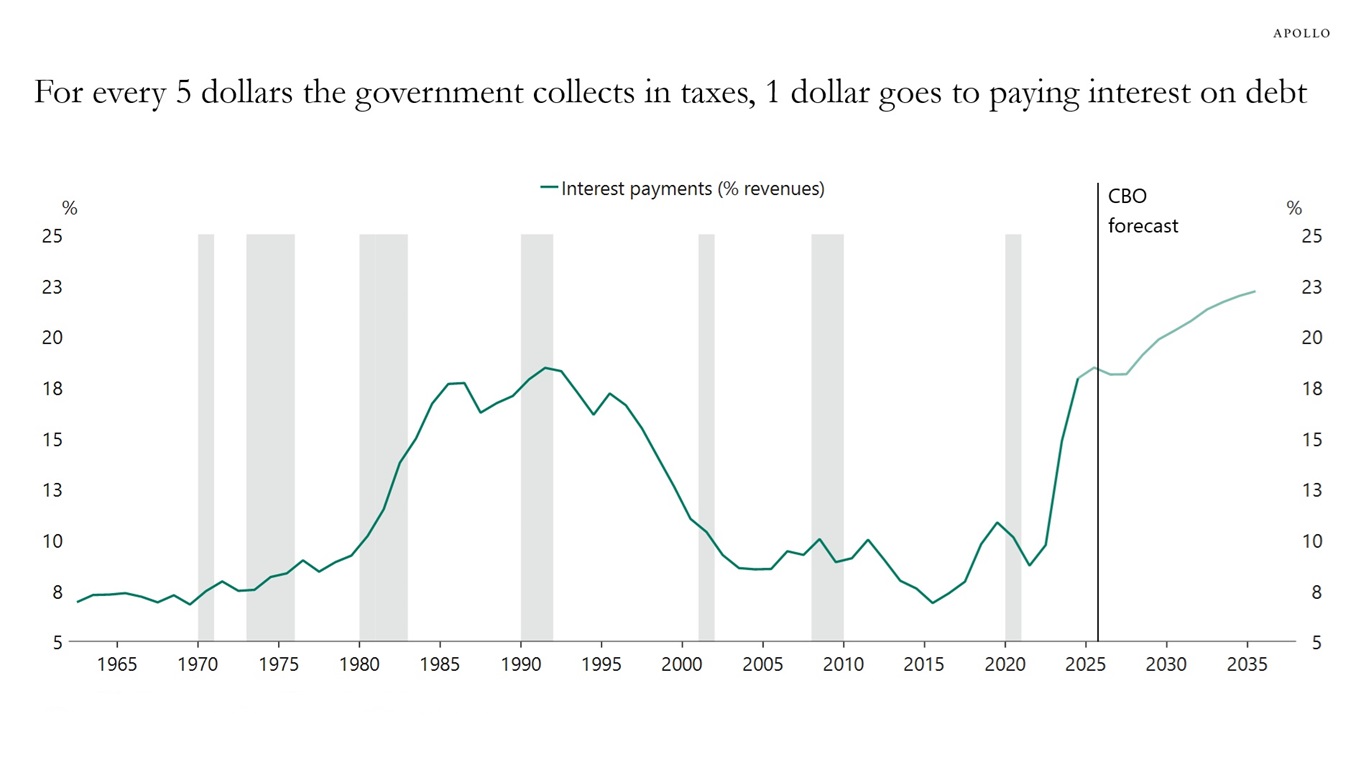
Apollo: For every five dollars the government receives in tax revenue, one dollar is spent on servicing the national debt, see chart.
Apollo
1 filters applied
Deep-DivesGlobalCurated insights across markets, macros, history, and intelligenceShowing 2 of 2
Distilling high-signal intelligence into digestible insights.
Deep-DivesGlobalShowing 2 of 2
Apollo: For every five dollars the government receives in tax revenue, one dollar is spent on servicing the national debt, see chart.
> "[Alexander Hamilton] was the primary architect of the American financial system... a system that is still the envy of the world." - **Consuelo Mack** (Introduction) [[00:00:15](https://youtu.be/JBt_ayWKBos?t=15)] > "Hamilton’s insight was that a national debt, if it is not excessive, will be to us a national blessing." - **Richard Sylla** (Discussing the Report on Public Credit)…

Apollo: For every five dollars the government receives in tax revenue, one dollar is spent on servicing the national debt, see chart.
"[Alexander Hamilton] was the primary architect of the American financial system... a system that is still the envy of the world." - Consuelo Mack (Introduction) [00:00:15]
"Hamilton’s insight was that a national debt, if it is not excessive, will be to us a national blessing." - Richard Sylla (Discussing the Report on Public Credit)…